
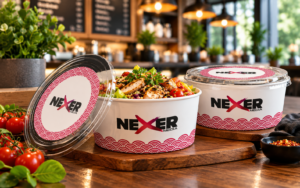
Packaging has become much more than a way to carry food.
For restaurants, cafés, bakeries, cloud kitchens, hotels, catering companies, and takeaway businesses, packaging is now part of the product presentation, customer experience, and brand identity. The moment an order reaches a customer’s hands, the packaging begins communicating something about the business behind it.
Does it look professional?
Does it protect the food properly?
Is it easy to carry?
Does it reflect the restaurant’s personality?
Does it feel considered rather than generic?
These questions are one reason kraft containers have become such an attractive option for modern food businesses.
Their natural brown appearance, practical construction, versatility, and excellent branding potential make kraft food packaging suitable for everything from restaurant meals and burgers to salads, bakery products, sandwiches, and takeaway dishes.
Kraft-based packaging can also fit into a broader strategy of reducing reliance on certain conventional single-use plastic formats. However, environmental performance depends on the complete packaging specification—including coatings, material sourcing, recycling systems, and disposal—so businesses should avoid treating every kraft product as automatically sustainable.
At NEXER MEDIA, businesses can combine professional printing and branding with packaging designed to make their products more recognizable. NEXER MEDIA already works with customized food and beverage packaging, with its website listing paper cups, PET cups and shopping bags among its printing services and customer feedback specifically mentioning customized paper bags and PET cups. Nexer Media
In this guide, we’ll explore why kraft containers have become a compelling choice for food businesses, how they can improve takeaway presentation, their branding potential, and how to choose the right kraft packaging for your products.
What Are Kraft Containers?
Kraft containers are packaging products manufactured primarily using kraft paper or kraft paperboard.
The word “kraft” comes from the manufacturing process used to produce strong paper fibers. The resulting material is widely recognized for its characteristic natural brown appearance, although kraft-based packaging can also be produced in other finishes and configurations.
For food businesses, kraft material can be converted into many different packaging formats, including:
- Kraft meal boxes
- Kraft takeaway containers
- Kraft burger boxes
- Kraft salad boxes
- Kraft sandwich boxes
- Kraft bakery boxes
- Kraft food trays
- Kraft paper bags
- Kraft takeaway bowls
- Kraft food cartons
Different products can use different coatings, barriers, constructions, and paper specifications depending on what they need to contain.
That distinction matters.
A dry pastry and a hot, oily takeaway meal do not have identical packaging requirements.
The correct kraft food container should therefore be selected according to the food, temperature, moisture, grease exposure, transportation requirements, and expected time between packing and consumption.
1. Kraft Packaging Creates an Attractive Natural Appearance
One of the first things customers notice about kraft packaging is its appearance.
Natural brown kraft has a distinctive visual character.
It can communicate ideas such as:
Craftsmanship.
Simplicity.
Freshness.
Minimalism.
Authenticity.
Natural presentation.
For this reason, kraft packaging works particularly well for businesses such as:
Specialty cafés.
Artisan bakeries.
Healthy food concepts.
Salad restaurants.
Burger restaurants.
Organic-style food brands.
Coffee shops.
Sandwich businesses.
Boutique restaurants.
Cloud kitchens.
The material already has visual personality before anything is printed on it.
Add professional custom branding and it can become a powerful extension of the business.
2. Kraft Containers Can Support More Sustainable Packaging Strategies
The movement toward more sustainable food packaging continues to influence restaurants and food businesses.
Companies are looking for ways to reduce unnecessary materials and reconsider their dependence on certain conventional single-use plastics.
Paper and paperboard products—including kraft formats—can form part of that transition.
NEXER MEDIA’s existing sustainability guidance similarly discusses kraft paper, recycled paper, bagasse, paperboard, and other alternative materials as businesses reconsider conventional food-packaging choices. Nexer Media
However, there is an important distinction between paper-based packaging and automatically calling something “100% eco-friendly.”
The environmental characteristics of a kraft container depend on factors including:
- Source of the paper
- Recycled content
- Barrier coatings
- Laminations
- Adhesives
- Printing inks
- Food contamination
- Local recycling infrastructure
- Waste collection
- Disposal method
A kraft container with certain plastic barriers, for example, may behave differently in recycling systems from an uncoated paperboard product.
Businesses should therefore make environmental claims based on the actual packaging specification they purchase.
The more responsible message is:
Choose packaging deliberately and understand the materials behind it.
3. Kraft Containers Can Reduce Dependence on Some Plastic Takeaway Packaging
Plastic has many valuable properties, particularly when moisture resistance, transparency, or specific barrier characteristics are required.
But not every takeaway product necessarily requires conventional plastic packaging.
For appropriate foods and applications, paperboard-based containers can provide another option.
A restaurant might use kraft containers for:
Rice meals.
Pasta.
Sandwiches.
Bakery products.
Burgers.
Salads.
Dry snacks.
Pastries.
Desserts.
Selected takeaway meals.
The exact suitability depends on the construction of the container and the characteristics of the food.
Moving appropriate products into paper-based formats can help a business reduce its reliance on some conventional plastic packaging while maintaining practical takeaway presentation.
4. Customers Notice Packaging
A customer’s experience doesn’t end when the food leaves the kitchen.
For takeaway orders, packaging becomes one of the most important physical touchpoints.
Imagine receiving the same meal in two different ways.
The first arrives in generic packaging with no recognizable identity.
The second arrives in a carefully selected kraft container featuring:
Your restaurant logo.
Brand colors.
A custom pattern.
Professional typography.
A small thank-you message.
Which feels more deliberate?
Packaging affects presentation before the customer takes the first bite.
This is why modern food businesses increasingly treat packaging as part of the customer experience rather than simply an operational expense.
NEXER MEDIA makes the same broader point in its restaurant-packaging guidance: customers continue interacting with a restaurant through the packaging they carry home, take to the office, or potentially share online. Nexer Media
5. Kraft Containers Can Make Takeaway Food Look More Premium
Food presentation matters.
Restaurants invest considerable effort in how meals look when served inside the restaurant.
Plates are selected carefully.
Ingredients are arranged.
Garnishes are added.
Colors are considered.
But when customers order takeaway, the plate disappears.
The packaging replaces it.
That means a kraft takeaway container becomes part of the presentation.
A well-designed container can make the order feel:
More organized.
More professional.
More deliberate.
More consistent.
More connected to the restaurant.
This is particularly important for restaurants offering premium takeaway meals.
If customers are paying premium prices, the packaging should ideally support the same perception of quality created by the food and service.
6. Kraft Packaging Provides Excellent Branding Opportunities
Natural kraft material can create an attractive background for custom printing.
Businesses can add:
Logo
The most important element for immediate recognition.
Brand Colors
A distinctive color can contrast beautifully against brown kraft.
Typography
Custom typography can communicate the personality of the restaurant.
Patterns
Illustrations, icons, or repeating graphics can make packaging easier to recognize.
Taglines
A short message can reinforce brand personality.
Website
Customers can find the business again.
Social Media Handle
Packaging can connect physical customers with digital channels.
QR Code
Customers can scan to order, review, follow, or join a loyalty program.
This turns custom kraft containers into much more than food boxes.
They become physical branding assets.
7. Minimal Branding Looks Particularly Effective on Kraft
One advantage of kraft material is that businesses don’t necessarily need complicated artwork to create attractive packaging.
Consider a simple kraft meal box featuring:
A large black logo.
One distinctive brand color.
A short tagline.
Nothing else.
That simplicity can look extremely polished.
Natural kraft already contributes texture and visual character, so minimalist branding often works particularly well.
Restaurants should resist the temptation to fill every available surface with information.
Packaging is not a brochure.
The objective is usually immediate recognition.
A customer should be able to glance at the container and know which restaurant it came from.
8. Kraft Containers Can Strengthen Brand Recognition
Customers remember brands through repeated exposure.
They see your logo on:
Instagram.
Your website.
Restaurant signage.
Menus.
Paper bags.
Coffee cups.
Food containers.
Delivery orders.
Each consistent interaction helps reinforce the same identity.
This is why custom kraft food packaging should follow the same visual system used elsewhere.
Use the same:
Logo.
Colors.
Typography.
Graphic elements.
Tone of voice.
NEXER MEDIA’s restaurant-packaging guidance similarly recommends consistent branding across products such as paper bags, coffee cups, PET cups, pizza boxes, burger boxes, food containers, stickers, and wrappers. Nexer Media
Consistency turns separate packaging products into one recognizable family.
9. Kraft Containers Are Ideal for Takeaway Businesses
Takeaway packaging needs to accomplish several things simultaneously.
It should:
Protect the food.
Make transportation practical.
Present the food professionally.
Support the brand.
Fit efficiently inside takeaway bags.
Remain suitable for the specific food application.
Kraft containers are available in a variety of forms, making them useful for many takeaway businesses.
For example:
Restaurants
Meal boxes and takeaway containers.
Burger Restaurants
Kraft burger boxes and side-food containers.
Cafés
Sandwich, pastry, and light-meal packaging.
Bakeries
Boxes for pastries, cookies, and baked products.
Healthy Food Businesses
Salad and meal containers.
Cloud Kitchens
Branded containers for delivery-first businesses.
Catering Companies
Individual meal packaging for events and corporate orders.
The correct format depends on what the business actually sells.
10. Kraft Containers Are Particularly Valuable for Cloud Kitchens
Cloud kitchens have an unusual branding challenge.
Customers may never physically visit the business.
There may be:
No storefront.
No dining area.
No visible kitchen.
No restaurant décor.
No physical menu.
The customer experiences the business primarily through:
The ordering platform.
Delivery.
Packaging.
Food.
That makes packaging especially important.
For a cloud kitchen, a branded kraft container can function almost like a miniature storefront delivered directly to the customer’s home.
A generic box tells the customer very little.
A professionally branded container communicates:
Who prepared the food.
What the brand looks like.
How to find the business again.
That physical identity can be valuable in a delivery-first market.
11. Kraft Food Packaging Can Improve Delivery Presentation
Delivery puts food through more handling than traditional dine-in service.
The order may travel from:
Kitchen.
Packing station.
Pickup area.
Delivery vehicle.
Customer’s building.
Elevator.
Front door.
Dining table.
Packaging must be chosen with that journey in mind.
The correct kraft container should account for:
Food weight.
Temperature.
Grease.
Moisture.
Travel time.
Stacking.
Ventilation where appropriate.
Closure design.
Bag dimensions.
Businesses should test packaging with real menu items under realistic delivery conditions before committing to large quantities.
A box that performs perfectly for a pastry may not be suitable for a hot, saucy meal.
Good packaging begins with the food—not the artwork.
12. Kraft Meal Boxes Can Create a Better Unboxing Experience
Food delivery has its own version of unboxing.
The customer receives the bag.
Removes the container.
Sees the branding.
Opens the lid.
Sees the meal.
Each stage contributes to the overall impression.
Imagine opening a kraft meal box with:
A clean exterior logo.
A small branded sticker.
A thoughtful message inside.
Food neatly arranged within.
That can feel much more deliberate than receiving food in completely anonymous packaging.
The goal isn’t to make takeaway unnecessarily complicated.
It’s to make the existing experience feel considered.
13. Kraft Containers Can Encourage Social Media Sharing
Food and social media are closely connected.
Customers frequently photograph:
Breakfast.
Coffee.
Lunch.
Desserts.
Restaurant meals.
Delivery orders.
Takeaway packaging.
If your branded kraft packaging appears in those photographs, your business can receive additional visibility.
Design with this possibility in mind.
Consider:
Where is the logo when the box is open?
Can customers photograph the food and brand simultaneously?
Are your colors recognizable?
Does the packaging look attractive from above?
Is your social handle easy to find?
A simple message could encourage participation:
Looks Good? Show Us. Tag @YourBrand
Or:
Share Your Meal With Us.
Packaging can therefore help connect offline purchases with online conversations.
14. QR Codes Can Make Kraft Packaging Interactive
One small QR code can dramatically expand what a food container can do.
It could direct customers to:
Online ordering.
Digital menu.
WhatsApp.
Website.
Google reviews.
Instagram.
Loyalty program.
Promotional page.
New products.
Restaurant locations.
The most important rule is to provide context.
Don’t simply print a mysterious QR code.
Tell customers why they should scan it.
For example:
Scan to Order Again
Scan to Join Rewards
Scan to Leave a Review
Scan to Explore Our Menu
Scan for Today’s Offer
Always test QR codes after printing before producing packaging in large quantities.
15. Kraft Containers Can Support Customer Loyalty
Restaurants spend considerable resources attracting customers.
Once someone has ordered, packaging provides an opportunity to make the next interaction easier.
The container could include:
Website.
Phone number.
WhatsApp.
Ordering QR code.
Social-media account.
Loyalty information.
For example:
Enjoyed Your Meal? Scan Here to Order Again.
Now the container isn’t simply part of the current order.
It creates a path toward the next one.
This can be particularly valuable for businesses that receive many orders through third-party platforms and want customers to become more familiar with the restaurant itself.
16. Custom Kraft Containers Can Promote New Products
Food businesses regularly introduce:
New meals.
Seasonal menus.
Desserts.
Drinks.
Special offers.
Branches.
Loyalty programs.
Packaging can support these campaigns.
For example:
New Menu Now Available
with a QR code.
Or:
Have You Tried Our New Signature Burger?
Restaurants can also use stickers to temporarily adapt standard kraft packaging for short-term promotions without redesigning every container.
This gives businesses flexibility while keeping the main visual identity consistent.
17. Kraft Packaging Works Well for Seasonal Designs
Restaurants and cafés can adapt packaging for important occasions such as:
Ramadan.
Eid.
UAE National Day.
New Year.
Restaurant anniversaries.
New branch openings.
Corporate events.
Special collaborations.
The base kraft appearance can remain consistent while graphics or stickers change.
This gives regular customers something new to notice without losing the core brand identity.
18. Kraft Containers Can Be Part of a Complete Packaging System
The strongest takeaway experience rarely relies on one packaging product.
Imagine a restaurant order containing:
Main meal.
Burger.
Coffee.
Cold beverage.
Dessert.
A coordinated system could include:
Kraft Meal Container
For the main dish.
Burger Box
For burgers and sandwiches.
Paper Coffee Cup
For hot drinks.
PET Cup
For cold beverages.
Kraft Paper Bag
For carrying the complete order.
Sticker
For sealing or additional branding.
If each product uses the same logo, colors, typography, and design language, the entire order feels connected.
NEXER MEDIA’s existing content emphasizes this approach to consistent packaging, where bags, cups, boxes, containers, stickers, and wrappers function as parts of one brand system rather than unrelated products. Nexer Media
For businesses wanting to build that coordinated presentation, explore NEXER MEDIA’s printing and branding services.
19. Kraft Containers Can Help Smaller Businesses Look More Established
Custom packaging isn’t reserved for multinational food chains.
It can be particularly valuable for independent businesses.
Consider a small restaurant with:
Excellent food.
Professional logo.
Strong reviews.
Good social-media presence.
But completely generic takeaway containers.
The customer experience becomes disconnected.
Using branded containers helps bring the physical product into the same identity.
Suddenly the restaurant looks consistent:
Online.
At the counter.
During delivery.
At the customer’s home.
Professional presentation can help a growing business look more established without changing the food itself.
20. Kraft Packaging Can Communicate Brand Personality
Different businesses can use the same basic material in completely different ways.
Premium Restaurant
Minimal black typography with subtle foil or carefully selected finishes where suitable.
Healthy Food Brand
Natural illustrations, green accents, and clean typography.
Burger Restaurant
Bold graphics, energetic messaging, and strong colors.
Bakery
Hand-drawn illustrations and warm typography.
Café
Minimal branding paired with matching coffee cups and paper bags.
Youth-Focused Food Brand
Bright colors, playful messages, and interactive QR codes.
The kraft material is simply the canvas.
The branding determines the personality.
21. Customers Appreciate Packaging That Is Easy to Use
Good packaging should not sacrifice convenience for appearance.
Customers care about practical details.
Can the container be carried comfortably?
Does it stay closed?
Is it appropriate for the meal?
Can it sit flat on a table?
Does it fit inside the takeaway bag?
Can customers open it easily?
Does the food arrive in good condition?
These questions matter more than decorative design.
The best kraft takeaway packaging combines:
Functionality + Presentation + Branding
A beautiful container that performs poorly will damage the customer experience rather than improve it.
22. Choosing the Right Kraft Container Size
Avoid selecting one container for every menu item simply because purchasing becomes easier.
Different foods may need different dimensions.
Consider:
Portion size.
Food height.
Side dishes.
Sauce containers.
Number of components.
Meal presentation.
Delivery stacking.
Bag dimensions.
Too small and the food may be compressed.
Too large and the meal can move around unnecessarily, presentation may suffer, and material may be wasted.
Test real portions before finalizing the packaging.
23. Consider Grease and Moisture
Food can place significant demands on paper-based packaging.
Burgers release moisture.
Fried foods contain oil.
Salads may contain dressing.
Hot meals can generate steam.
Sauces can leak.
That means businesses should choose a kraft container designed for the specific application.
Some products may require grease-resistant or moisture-resistant barriers.
But these treatments can also affect end-of-life characteristics.
This is another reason to avoid assuming that every brown kraft box has identical environmental properties.
Ask your supplier what the container is designed to handle and what materials or coatings are involved.
24. Be Accurate With Eco-Friendly Claims
The word eco-friendly is powerful in marketing.
It should also be used responsibly.
A business shouldn’t assume:
Brown = sustainable.
Paper = automatically recyclable everywhere.
Kraft = automatically compostable.
Instead, understand the product.
Ask:
Is recycled material used?
Does it contain a coating?
Can that coating be separated?
What disposal route is recommended?
Is it accepted by local recycling infrastructure?
Is the product certified for any specific environmental claim?
NEXER MEDIA’s own sustainability guidance makes a similar point: paper packaging can support efforts to reduce dependence on conventional single-use plastic, but material construction and waste-management conditions still matter. Nexer Media
Clear, supportable communication builds more customer trust than exaggerated green claims.
25. Kraft Packaging Can Support a Natural Brand Story
For businesses already positioned around ideas such as:
Fresh ingredients.
Handmade food.
Artisan production.
Minimalism.
Craftsmanship.
Local products.
Natural aesthetics.
kraft packaging can visually complement the story.
A bakery focused on handcrafted bread, for example, may find natural kraft packaging more visually appropriate than glossy, brightly colored plastic packaging.
A specialty café can coordinate kraft food containers with natural paper bags and custom coffee cups.
The packaging reinforces what customers already understand about the brand.
26. Avoid Overdesigning Kraft Containers
Natural kraft has visual texture.
Let it work.
Common mistakes include:
Too many colors.
Tiny text.
Several logos.
Long paragraphs.
Too many icons.
Multiple promotions.
Oversized QR codes.
Several social handles.
Competing taglines.
Instead, establish hierarchy.
First:
Brand.
Second:
Product experience or tagline.
Third:
Digital CTA or useful information.
Customers should understand the packaging in seconds.
27. Design the Packaging for Photography
Customers increasingly encounter restaurants visually.
Even if they don’t photograph your packaging themselves, your business probably will.
Custom kraft containers may appear in:
Product photography.
Instagram posts.
Meta ads.
Reels.
Website banners.
Delivery-platform images.
Printed menus.
Promotional campaigns.
Therefore, consider how the container looks:
Closed.
Open.
Stacked.
Inside a bag.
Beside food.
From above.
In someone’s hand.
Good packaging design becomes a reusable visual asset for the business’s marketing.
28. Custom Kraft Packaging Can Create Mobile Brand Visibility
Containers often travel inside branded paper bags, but they can still create visibility at:
Offices.
Universities.
Hotels.
Food courts.
Events.
Parks.
Meetings.
Shared dining spaces.
NEXER MEDIA’s packaging guidance describes branded takeaway packaging as a mobile brand touchpoint because customers carry restaurant identity beyond the premises. Nexer Media
The principle applies to the broader takeaway system.
Every branded packaging item creates another opportunity for somebody to encounter the business.
29. Build Packaging Around the Customer Journey
Rather than selecting packaging products individually, map the complete customer experience.
For example:
Step 1: Order
Customer orders online.
Step 2: Preparation
Restaurant prepares the meal.
Step 3: Packing
Food goes into a branded kraft container.
Step 4: Carrying
Containers are placed inside a matching branded paper bag.
Step 5: Delivery
Customer receives a professional-looking order.
Step 6: Opening
Branding remains visible as the meal is unpacked.
Step 7: Eating
The container remains on the table.
Step 8: Digital Interaction
A QR code offers reordering, reviews, or social engagement.
Now packaging becomes integrated into the entire journey.
That is far more valuable than viewing it simply as “the box we put food in.”
30. Why Kraft Containers Are a Smart Choice for Modern Food Businesses
Kraft containers are appealing because they can address several business needs simultaneously.
They can provide:
Practical takeaway packaging.
Natural visual presentation.
Large branding surfaces.
Multiple shapes and sizes.
Compatibility with coordinated packaging systems.
Potential alternatives to some conventional plastic formats.
Strong visual identity.
Customer-facing marketing opportunities.
For businesses operating in competitive food markets, that combination can be valuable.
Customers increasingly experience restaurants outside the dining room.
The packaging delivered to their home or carried back to their office may be one of the strongest physical impressions the business creates.
Make it count.
How NEXER MEDIA Can Help Create Branded Food Packaging
The best packaging isn’t simply attractive.
It should fit the food, customer, and brand.
NEXER MEDIA provides professional printing and branding solutions that can help businesses create a more consistent physical identity.
Its current printing portfolio includes shopping bags, paper cups and PET cups, and customer feedback on the company’s website specifically mentions customized paper bags and PET cups. Nexer Media
For restaurants, cafés, bakeries, juice bars, hotels, takeaway businesses, and cloud kitchens, a broader coordinated packaging system can include products such as:
- Kraft containers
- Meal boxes
- Burger boxes
- Pizza boxes
- Custom paper bags
- Paper coffee cups
- PET cups
- Food wrappers
- Stickers
- Other branded packaging materials
The objective is not simply to print a logo everywhere.
It is to create a recognizable system in which every packaging item looks like it belongs to the same business.
Explore NEXER MEDIA for professional printing, branding, and custom packaging solutions.
Frequently Asked Questions About Kraft Containers
What are kraft containers?
Kraft containers are paper or paperboard-based packaging products commonly recognizable by their natural brown appearance. They are available in different formats for meals, burgers, salads, bakery products, sandwiches, takeaway foods, and other applications.
Are kraft containers eco-friendly?
Kraft and other paper-based formats can form part of a strategy to reduce reliance on certain conventional single-use plastics, but the environmental performance of a specific container depends on its paper source, coatings, inks, construction, recycling infrastructure, contamination, and disposal method. Businesses should verify the actual specification before making environmental claims.
Can kraft containers be custom printed?
Yes. Depending on the product and printing method, kraft packaging can incorporate logos, colors, typography, patterns, QR codes, websites, social-media handles, and promotional messages.
Are kraft containers suitable for hot food?
Some kraft food containers are designed for hot-food applications, but suitability depends on their construction, barrier properties, temperature limits, moisture, grease exposure, and the specific food. Confirm the intended use with the packaging supplier.
Can restaurants put QR codes on kraft packaging?
Yes. QR codes can direct customers to online ordering, menus, websites, WhatsApp, loyalty programs, social-media profiles, review pages, or promotional campaigns.
Are kraft containers good for restaurant branding?
Yes. Their printable surfaces allow restaurants to create packaging using consistent logos, colors, typography, and other brand elements. NEXER MEDIA’s packaging guidance similarly emphasizes consistency across takeaway bags, cups, boxes, containers, stickers, and wrappers. Nexer Media
Where can businesses get custom branded packaging?
Restaurants, cafés, bakeries, hotels, and other businesses can explore professional printing and branding solutions through NEXER MEDIA.
Conclusion: Packaging Customers Can Recognize, Use and Appreciate
Kraft containers represent much more than a packaging trend.
For modern food businesses, they offer an opportunity to rethink what takeaway packaging should accomplish.
The container needs to hold the food.
But it can also:
Improve presentation.
Reinforce branding.
Create a more professional delivery experience.
Connect customers with digital channels.
Encourage repeat interaction.
Complement paper bags, cups, and other packaging.
Support efforts to reconsider unnecessary conventional plastic packaging where appropriate.
And create an aesthetic that many modern restaurants, cafés, and food brands find attractive.
The key is choosing packaging intelligently.
Not every kraft container has identical environmental properties.
Not every food requires the same construction.
And the most sustainable-looking package isn’t necessarily the most appropriate one.
Start with functionality.
Understand the material.
Then use professional branding to transform that practical container into something customers recognize.
Good packaging carries the food. Great packaging carries the food, the experience, and the brand.
For custom printing and branded food-packaging solutions, visit NEXER MEDIA and start creating packaging designed to make every takeaway order look unmistakably yours.